
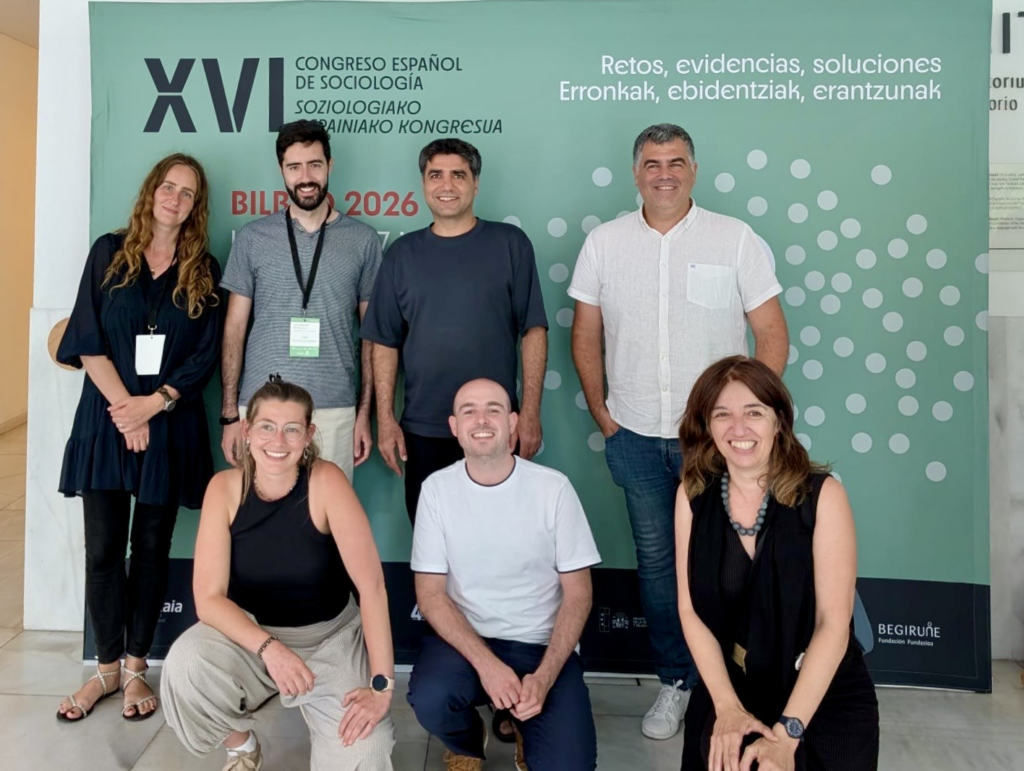
On the occasion of the XVI Spanish Congress of Sociology (FES) held in Bilbao, we held the first in-person meeting of the “Transnational care strategies in contexts of authoritarian regimes” (ECTRA) R&D project team with our partners at the UPV/EHU: Gorka Moreno, Julia Shershneva, and Oier Ochoa de Aspuru.
ECTRA is an R&D project funded under the 2024 call for Knowledge Generation Projects (Ministry of Science, Innovation and Universities / State Research Agency), with a duration of 36 months and led by Dr. Sònia Parella Rubio. The team consists of researchers from the UAB (CER Migracions) and the University of the Basque Country (UPV/EHU), including Gorka Moreno, Julia Shershneva, and Oier Ochoa de Aspuru, alongside international collaborators in Iran, Cameroon, and Nicaragua, and the collaboration of Ikuspegi – Basque Immigration Observatory.
The project analyzes how authoritarian contexts in countries of origin —Iran, Cameroon, and Nicaragua, selected to represent different types of authoritarianism across different continents—impact the transnational care strategies of migrants residing in Spain and their families in origin. ECTRA focuses on a previously understudied aspect: how repression, surveillance, and mobility restrictions in the country of origin, and not merely the migration policies of the destination country, generate what the literature terms “disruptive care relations”. The approach transversally incorporates a gender and intergenerational perspective, analyzing the impact on migrant well-being, power dynamics within transnational families, and integration processes in Spain.
The study combines qualitative techniques: biographical interviews, focus groups, and digital ethnography through the analysis of migrant communities on Telegram, WhatsApp, and Facebook. The project unfolds in four successive phases: desk review and methodological design, fieldwork, data analysis and the development of a comparative framework, and knowledge transfer. Over its three-year duration, it aims to generate public policy recommendations, publications in high-impact indexed journals, presentations at national and international conferences, and outreach materials aimed at the academic community, migrant communities, and society at large.