
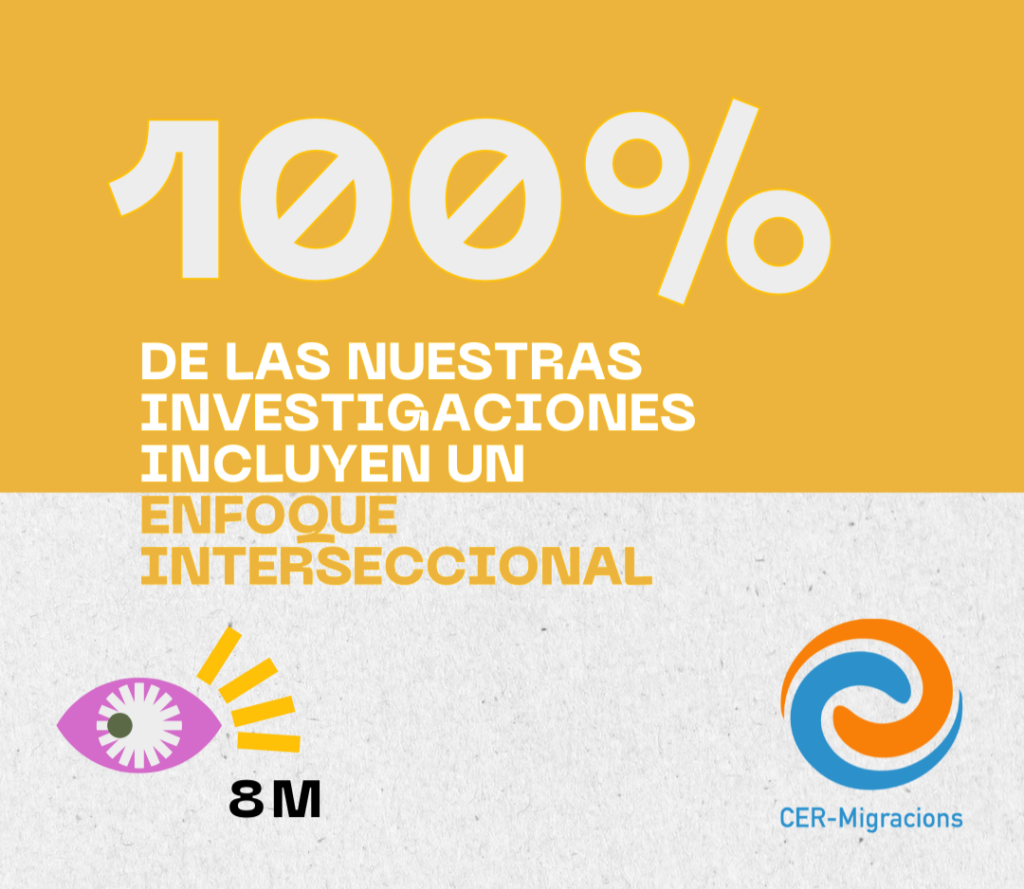
To mark International Women’s Day (8M), the CER-M celebrates its scientific output (2022–2026), which features female leadership. With 100% of its studies incorporating a gender perspective, the centre promotes social justice and more inclusive public policies.
Since 2009, the CER-M (Centre for Mobility Studies and Research) has established itself as a benchmark in scientific research, driven by a diverse team where female leadership shines with particular strength. The most recent review (2022–2026) reflects that our intellectual output has been led by women researchers: of the 48 publications produced during this period, 15 were led by our female researchers (31.25%), while a further 14 involved the fundamental collaboration of women as co-authors and partners from other centres, bringing female participation to 60.4% of the total output. This reinforces the group’s commitment to valuing women’s contributions to science and its openness to collaborations that serve to build an even broader and more informed knowledge of immigration in its multiple facets.
Furthermore, 100% of our projects and publications incorporate a gender perspective. That is to say, in every study conducted by our researchers, the social dynamics experienced by immigrants are analysed alongside how gender impacts their experiences in an intersectional way.
Going further, we are proud to highlight that 6 projects and 19 publications were specifically dedicated to in-depth research into the experiences of migrant women, placing realities that often remain on the fringes at the heart of the academic debate. The themes of these specific outputs are as urgent as they are diverse, ranging from strategies to prevent gender-based violence and support for migrant mumpreneurs, to the valuation of care work and urban resilience through an inclusive lens. By addressing issues such as the impact of COVID-19 on domestic workers and forced migration, the CER-M transforms science into a tool for social justice.
The impact of this output goes far beyond universities. By documenting and analysing the trajectories of migrant women and workers, the CER-M provides scientific foundations for the creation of public policies that make cities and institutions more welcoming. This inclusive science not only produces knowledge but also seeks to contribute to fairer trajectories, ensuring that no one is left behind. Together, we continue to drive science forward with excellence and diversity!