
To mark 25 November, the International Day for the Elimination of Violence against Women, it is essential to highlight how gender inequalities intersect with other forms of inequality in migration contexts.
According to a study published in May 2026 by the Spanish Government Delegation against Gender-Based Violence, drawing on the 2024 Survey on Violence against Women, 34.9% of foreign-born women residing in Spain have experienced some form of violence perpetrated by a current or former partner during their lifetime. These figures highlight the need to understand violence against women from an intersectional perspective, considering factors such as immigration status, employment insecurity, racialisation and barriers to accessing protection services.
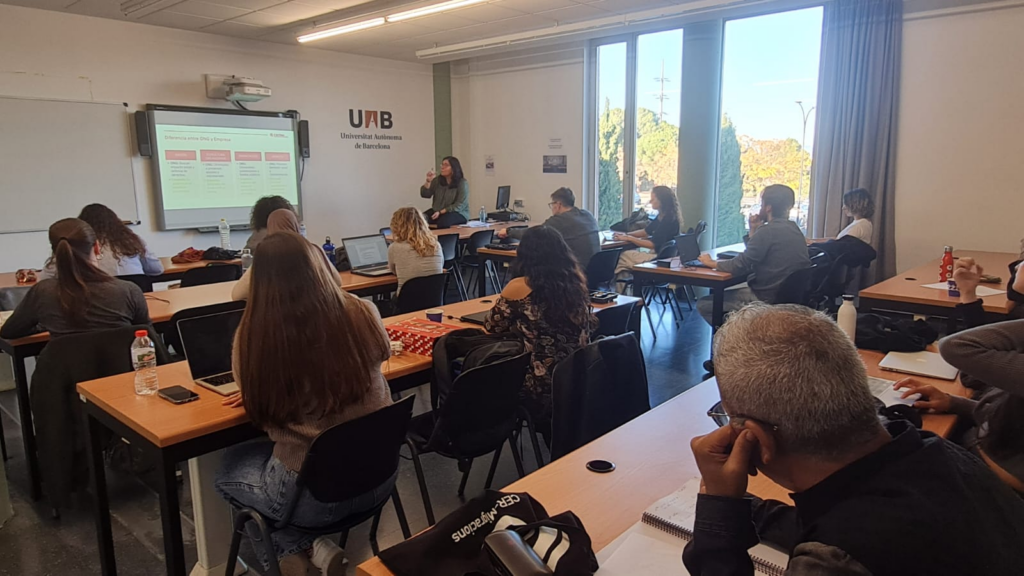
At CER-M, we contribute to addressing this reality through the education and training of professionals and researchers specialising in migration. In particular, the Interuniversity Master’s Degree in Contemporary Migration integrates a gender perspective across different modules and teaching sessions, providing students with theoretical, methodological and practical tools to understand the inequalities and different forms of violence that shape migrant women’s experiences.
The modules Public Policies and Diversity Management and Innovative Migration Management, Social Mobilisation and Transformation explore the relationship between gender and migration, the impact of migration policies on women’s rights, and the importance of incorporating a gender perspective into reception and support processes. These sessions benefit from the contributions of professionals such as Catarina Alves and Fàtima Ahmed El Haddad, from Diàlegs de Dona, who introduce students to different perspectives and experiences in social intervention.
The module Labour Market: Labour Rights and Integration Processes examines gender inequalities in the labour market, addressing issues such as care work, sex work, labour exploitation, human trafficking and strategies to promote the social and labour market inclusion of migrant women. These sessions feature contributions from Catarina Alves, Iseo Morillas, Sira Vilardell and Giovanna Leuzzi, as well as Verónica Asensio and Begoña Martínez, from Barcelona City Council’s Anti-Human Trafficking Unit.
Legal frameworks and protection mechanisms are explored in the module Foreign Nationals in Vulnerable Situations: Rights and Protection, with sessions delivered by Giovanna Leuzzi and Cristina Zamora on the protection of victims of human trafficking and the legal treatment of situations of vulnerability related to gender and sexual orientation in the context of violence. In addition, as part of the Professional Placements module, Berta Güell addresses the integration of a gender perspective into research project design, contributing to the production of knowledge that can identify and raise awareness of these inequalities.
On this 25 November, CER-M reaffirms its commitment to higher education that contributes to understanding, preventing and combating violence against women in migration contexts. Bringing together academic knowledge, professional expertise and the work of public authorities and civil society organisations is essential to building a society in which all women, regardless of their origin or immigration status, can fully exercise their rights and pursue their aspirations free from violence.